Workplace wellbeing · 14 April 2025 · 16 min read
The coffee break: an underrated lever for your employer brand
The office coffee break is much more than a simple interruption in the working day. This ritual, often informal and sometimes overlooked, plays a central role in the quality of office life. At a time when employees’ expectations are changing, mental fatigue is growing and values carry more and more weight in HR decisions, rethinking break time becomes a strategic move.

Whether it is sharing a cup of coffee, chatting with colleagues or simply taking a few minutes’ rest, the break builds connections, strengthens team cohesion and contributes to a calmer working atmosphere. It acts as a real lever for conviviality, communication and recognition, helping to create a more human and more sustainable working environment. It directly influences job satisfaction, productivity and even the employer brand.
And yet few companies give this daily moment the attention it deserves. How many break areas are uninviting, poorly equipped or lacking good coffee? How many employees gulp down their drink standing next to a coffee machine, for want of a place to relax? A break should not be reduced to a coffee taken on the run. Well designed, it becomes an anchor point in company culture, a breathing space in the middle of the day and a clear signal to teams: here, we take care of you.
Why rethink breaks at work today?
Ways of working have changed profoundly in recent years. Remote working, greater flexibility, a growing mental load: these new practices are transforming how employees experience their working day. Traditional landmarks are fading, rest periods are becoming blurred, and the need for simple, human, structuring rituals is felt more and more.
In this context, the office coffee break regains strategic importance. It lets people catch their breath, briefly switch off and chat with colleagues without an immediate goal. These few minutes, well woven into the rhythm of the day, have a direct effect on attention, concentration and the ability to stay engaged over time. In Switzerland, several studies highlight the positive impact of these breathing spaces on stress, productivity and social connection at work.
Neuroscience also confirms the benefits of breaks for our brain. According to a study by the University of Illinois, our brain can only sustain attention for about 45 minutes. Beyond that, without a break, productivity drops significantly. The coffee break acts as a "mental reset" that lets you return to your task with fresh eyes and better concentration. These moments of disconnection are essential to foster creativity and the emergence of new ideas.
Employees’ expectations are changing too. They are looking for more consistency between the commitments their employer displays and the reality they experience every day. A dedicated relaxation space, quality coffee, responsible or local products: these all help create a more respectful and more motivating workplace. They strengthen the feeling of being valued, while making the most of the micro-moments that make up office life.

For HR and management, these breaks become a real lever. They make cross-team exchanges easier, ease tensions and keep the collective momentum going, even in hybrid set-ups. Offering a well-designed moment of relaxation also reduces the risks linked to overload, chronic stress or isolation, especially for teams working partly from home.
From an employer brand perspective, these everyday moments take on their full value. They shape the employee experience, influence how future candidates see the company and give substance to a more human internal culture. In a country like Switzerland, where people drink several cups of coffee a day, simply offering good coffee in good conditions can make a real difference.
A good break: what are the benefits for businesses?
A well-designed break is not a waste of time (or money), but a genuine investment in collective performance. When it is organised in the right setting, valued by the company and open to all employees, it becomes an HR management tool that is as simple as it is effective.
First, the benefits for quality of working life are well documented. Being able to step out of the flow of the day for a few minutes improves concentration, reduces the feeling of overload and acts as a natural boost. Moderate coffee consumption is known for its positive effects on alertness and attention, provided it is offered in a balanced setting, with a suitable machine, quality coffee and, where possible, lactose-free or decaffeinated alternatives.
MIT research has even quantified the impact of these breaks: teams that take coffee breaks together can see their productivity rise by up to 20%. This is explained in particular by the synchronisation of biological and social rhythms within teams. Professor Alex Pentland, who led the study, notes that "informal conversations over coffee allow information to flow more smoothly and more quickly than in formal meetings". What's more, during these moments of relaxation the brain releases dopamine and serotonin, neurotransmitters associated with wellbeing and motivation.
Next, the break fosters social connection. It offers a space for informal exchange, away from formal meetings or digital communication. It is often over a milky coffee or a piece of fruit that ideas flow, tensions are defused and team spirit grows stronger. At a time when working life is increasingly fragmented, especially with the rise of part-time remote working in Switzerland, these shared moments take on even greater value.
Finally, building well-structured breaks into the day supports the organisation's CSR strategy. Serving organic, fair-trade coffee, offering whole-bean coffee freshly roasted by a local roaster, cutting waste at source or providing plant-based milk alternatives: these simple steps are part of a responsible consumption approach, consistent with the company's commitments. These choices strengthen the company's credibility with its employees, as well as with its partners and external stakeholders.
The break thus becomes much more than a habit for employees or a cost item for employers. It becomes a lever for social performance, a tool for team cohesion, and a tangible symbol of the care given to teams. In offices as in busy common areas, it deserves a real place in discussions about sustainable work.
What the studies and figures tell us
In Switzerland, coffee is much more than just a drink: it is a pillar of working life. According to a Selecta study, the Swiss drink more than 4.5 million coffees a day at work or on the move.
Breaks as a driver of performance and retention
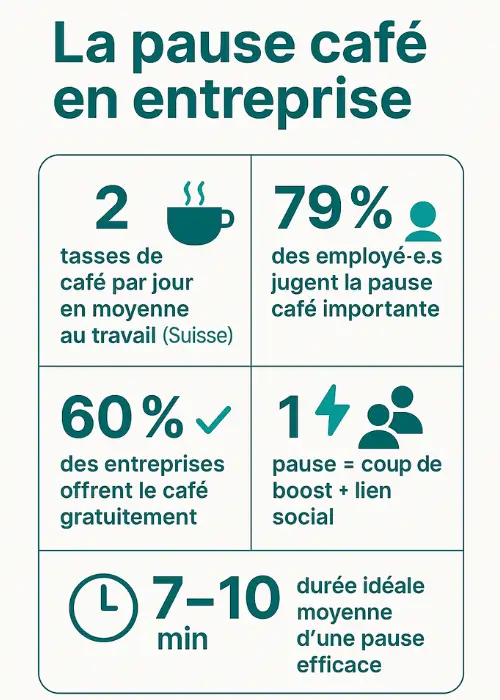
A survey by Handelszeitung reveals that nearly 40% of Swiss companies charge their employees for coffee, while 60% offer it free of charge. According to Kathrin Neumüller, an employee survey expert at the Swiss institute Value Quest, free coffee symbolises the employer's esteem and care, encouraging social exchange between colleagues. Conversely, charging for it can be seen as petty and harm company culture. To explore the topic further, read our full article on office coffee: free, paid or hybrid?. A study published in the Journal of Applied Psychology confirms these observations: shared coffee breaks strengthen the sense of belonging and reduce staff turnover by 10 to 15%. Furthermore, according to the Observatoire de la qualité de vie au bureau, companies that invest in friendly break areas see a 12% drop in absenteeism. These figures show that the break is an investment with a measurable return, well beyond the simple cost of the coffee.
Quality of working life, a priority for employees
The 2017 Swiss Health Survey shows that 22% of employees in Switzerland often or always feel stressed at work, compared with 18% in 2012. Working conditions in large companies (25%), among young women (28%) and in the hospitality and catering sector (33%) are often linked to stress. Preventing stress is therefore a challenge, as various factors can harm health.
CSR consistency as a source of motivation
A 2022 study by Michael Page of 4,755 workers in continental Europe, including Switzerland, found that 40% of respondents say the absence of a sustainability programme would affect their decision whether to join a company. What's more, 86% of young people prefer to support or work for organisations that care about the same issues as they do, and 30% have already left a company because it had no sustainability programme.
What makes a “good” break today?
In organisations that put wellbeing at the heart of how they work, the break is no longer just a pause between two tasks. It becomes a structuring time in the day, with shared benefits for teams and the company alike. To be beneficial, a well-designed break rests on several complementary dimensions: space, time, the quality of what is on offer, meaning and ritual.
Management experts such as Camille Lévy, a consultant in quality of working life, recommend the “90-20” technique: after 90 minutes of intensive work, take a 20-minute break. This method follows the brain’s natural attention cycles and helps maintain optimal productivity throughout the day. “A break should be a real break, not just a change of task,” she explains.
Space is the first key to success. Setting up a dedicated relaxation area, however modest, shows real attention to working conditions. It could be a pleasant kitchen, a sofa corner, an accessible terrace or a food area equipped with smart fridges. These spaces become places for spontaneous encounters that strengthen team spirit, encourage conversation and let everyone catch their breath in a welcoming setting.
Break time must also be respected, valued and built into the team's rhythm. It is not just about having a coffee break, but about guaranteeing a real right to rest, whether it is the lunch break, a pause late in the morning or a quarter of an hour set aside to get away from the screen. This organisation plays an essential role in preventing stress, supporting mental recovery and improving the quality of human interaction. The quality of what is offered during these breaks also has a direct impact. Freshly roasted whole-bean coffee, seasonal fruit, local products, organic tea or a well-chosen "healthy" drink: these touches show that the company takes its teams' preferences and wellbeing into account. These choices also help limit certain excesses (sugar, snacking), often linked to fatigue or a poorly regulated pace.
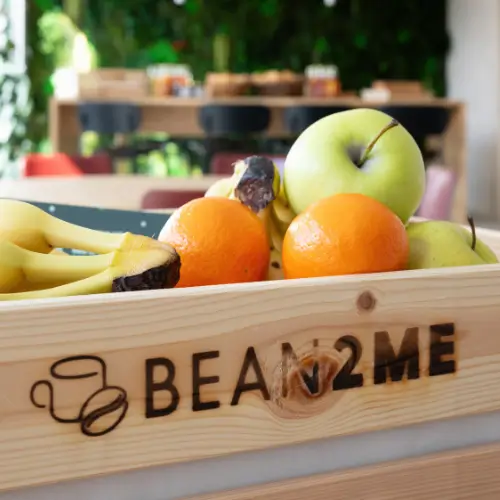
The meaning behind the break matters just as much. Choosing short-supply-chain products, limiting packaging, working with responsible local providers, setting up a zero-waste supply system: all these steps reflect a concrete commitment to responsible consumption. They contribute to the company’s overall consistency and strengthen employees’ buy-in to its values.
Finally, turning breaks into smart rituals can amplify their positive effects. Offering a shared breakfast every week, setting up a team break on Friday afternoons, holding a coffee moment to welcome new talent, or even organising a monthly team lunch: these simple initiatives create positive landmarks and fuel collective momentum. They help anchor the break as a structuring part of office life.
An opportunity for HR, CSR teams and senior management
Today, the way a company thinks about, frames and values breaks says a lot about its management culture. It is no longer just a moment of rest, but a powerful indicator of internal dynamics, sometimes more telling than any corporate statement.
Giving people time to catch their breath, creating an accessible, pleasant space, offering carefully chosen products: these decisions reflect a certain attitude to work, respect and trust. They show that employees are seen as individuals in their own right, not just as productive resources. It is also a marker of modernity: rigid organisations, where every minute of break time is suspected of being abuse, struggle to retain talent.
For HR and management alike, the break becomes a practical lens. It shows how much attention is really paid to wellbeing. It reveals whether the company can put its CSR commitments into practice day to day, or whether they stay confined to official presentations. It also highlights the quality of the relationship between managers and teams: a well-enjoyed break is often the sign of a calm atmosphere, a manageable workload and a balanced working environment.
It is also an implicit form of recognition. Offering good whole-bean coffee, making room for a moment of relaxation, organising a team breakfast, granting a well-deserved break after a sprint: all of this builds trust, a sense of belonging and long-term engagement. In a working world where mental fatigue is rising and expectations keep growing, this attention to the “little things” can make a big difference.
In short, the break plays a far more strategic role than it seems. It creates value, keeps energy flowing through teams, and becomes a real lever for livening up office life while embodying the company’s values.
How Bean2me can support you in practice
At Bean2me, we believe the break is not a detail. It is an integral part of the employee experience, responsible management of working time and company culture. That is why we have developed an offer tailored to the needs of Swiss businesses, whatever their size, sector or way of working.
We offer capsule-free office coffee solutions, designed to last and to adapt to your teams’ habits. Our automatic coffee machines let you enjoy whole-bean coffee freshly and artisanally roasted in Switzerland, with consistent quality and simple operation. It is a sustainable alternative to capsules, and a real efficiency gain for the managers and office managers in charge of the coffee service.
To go further, we support each company in choosing equipment, setting the delivery frequency, laying out spaces and providing complementary products such as fresh fruit or healthy snacks. Every project takes into account each company’s specific needs and the preferences of both management and employees, so as to put in place a solution that works for everyone.
Our coffees are specially selected and roasted for optimal extraction on the automatic machines used in offices. They come in 1 kg compostable bags certified “OK COMPOST”, or in 5 kg returnable buckets for organisations that want to go further in reducing waste. Our entire offer is built on restraint, quality and responsibility, to improve the office break without generating unnecessary waste.
We also make a point of giving you clear indicators, so that every decision is based on concrete evidence. Whether you want to boost your teams’ wellbeing, offer a service aligned with your CSR commitments, or simply serve coffee that makes sense, we are here to build the solution that suits you.
Bean2me is the art of combining taste, commitment and simplicity, at every break.
Give your teams a better break
Testimonials and real-life examples
Many Swiss companies have already moved their approach to breaks towards formats that better reflect their values. Here are two examples of simple, effective changes that were widely appreciated internally.
Banque Raiffeisen Genève Lac: making the break a mark of high standards and consistency
When it moved offices, Raiffeisen completely rethought its shared spaces, in particular the central break area and client reception. The aim: to create a warm space, in keeping with the company’s culture, that values employees and visitors alike.
JURA machines were installed on every floor to guarantee quality whole-bean coffee at any time. Kusmi Tea is also available, alongside fresh fruit delivered every week. On top of that, regular team breakfasts are organised and have become a much-loved ritual.
The results are clear: employees who appreciate a thoughtful, friendly break, and clients welcomed in a caring setting that matches the bank’s image.
JDR Énergie: saying goodbye to capsules, without the hassle
At JDR Énergie, the old capsule machine no longer met the teams’ expectations or matched the company’s image. A JURA machine was installed in the break area, with coffee beans delivered automatically every month. The installation was simple, quick and, above all, very well received. The team praised the better-tasting coffee, the reduction in waste and the feeling of a step up in their daily routine. The benefit is environmental, economic and human.
These examples show that improving the break does not need to be complex or costly. A well-thought-out change can be enough to transform the employee experience, strengthen buy-in to the company’s values and show genuine care for wellbeing.
Why not try the Bean2me coffee break?
Receive a coffee machine with coffee beans for 7 days, or a fruit basket delivered to your offices. No commitment
In short: a small gesture, a lasting impact
A break at work is not a mere comfort. It is a structuring moment in the day, a right enshrined in employment law and, above all, a driver of engagement that too few organisations make the most of. Whether it is a well-made coffee, a moment shared with colleagues or a daily moment of rest, these recovery times play a decisive role in the overall balance of teams.
At a time when digital tools are stretching the working day, it is essential to give the break its rightful place again. It helps reduce the risks linked to mental load and sedentary work, while rebuilding real connections in a professional environment often marked by fragmented interactions, increasingly driven by screens and social media.
As Sophie Prunier-Poulmaire, professor of ergonomics, points out, "a break is not a luxury but a physiological and cognitive necessity". According to her research, a 15-minute break every two hours not only helps maintain attention but also prevents musculoskeletal disorders and improves mental health. The return on investment is therefore threefold: employee wellbeing, higher productivity and lower costs linked to absenteeism and staff turnover.
Rethinking the break does not mean adding a constraint. It means giving meaning to a daily ritual, by choosing quality products, suitable formats, a reliable coffee machine, or a space that brings employees together. It is also a strong message from management and HR: here, we care about people, not just productivity.
A well-designed break, even a short one, can therefore strengthen team spirit, give an energy boost and improve morale and concentration, while staying within the rules and collective agreements. It is an HR topic in its own right, with many benefits for employees and the company alike.
What if, in the end, the best strategy for improving office life started with better organising… your break time?